Multi-Agent Systems Explained: How Teams of AI Agents Work Together
On this page
Multi-agent systems are AI setups in which several agents, each a model using tools, work together on one task. A lead agent splits the work, specialists handle the parts in parallel or in sequence, and the results are combined. They can beat a single agent on broad research, but cost far more and fail often.
This guide explains how multi-agent systems work, the main orchestration patterns, when they beat a single agent and when they don't, what they cost, why they fail, the frameworks and protocols behind them, the security risks, and how businesses — including UAE government entities and real-estate firms — are using them.
Key takeaways
- It's a team, not a smarter model. A lead agent plans and delegates; specialist agents do parts of the work; someone, or something, checks the result.
- It wins on breadth and loses on sequence. Across 260 tested configurations, multi-agent setups gained up to 80.8% on tasks that split cleanly and lost 39% to 70% on step-by-step planning.
- It's expensive. Anthropic measured multi-agent systems using about 15 times the tokens of a chat.
- It fails often. A peer-reviewed study found failure rates of 41% to 86.7% across seven open-source multi-agent systems, mostly from design and coordination problems.
- The plumbing has standardised. MCP (agents to tools) and A2A (agents to agents) now sit under the Linux Foundation, and the UAE plans to move half its government operations to agentic AI by 2028.
What is a multi-agent system?
A multi-agent system is a group of AI agents that work together on a goal, each with its own role, tools and context. Instead of one agent doing everything, work is divided among specialists and coordinated, usually by a lead agent.
Definition
Multi-agent system — several AI agents, each a language model using tools in a loop, working together on one task (Anthropic). Gartner describes them as collections of AI agents that interact to achieve individual or shared complex goals.
| Single agent | Multi-agent system | |
|---|---|---|
| Structure | One model with a set of tools | A lead agent plus specialist agents |
| Context | One context window holds everything | Each agent has its own context and hands back a summary |
| Strength | Coherent, sequential work; simpler to debug | Parallel, breadth-first work; separating concerns |
| Cost | Lower | Several times higher |
| Main risk | Overloaded context or too many tools | Coordination failures and compounding errors |
The difference from ordinary automation matters too. In a workflow, code decides the path; in an agent, the model decides its own next step. Multi-agent systems combine both: some are fixed pipelines of agents, others let a lead agent decide whom to call. For what agents are and how they act, see agentic AI explained.
How do multi-agent systems work?
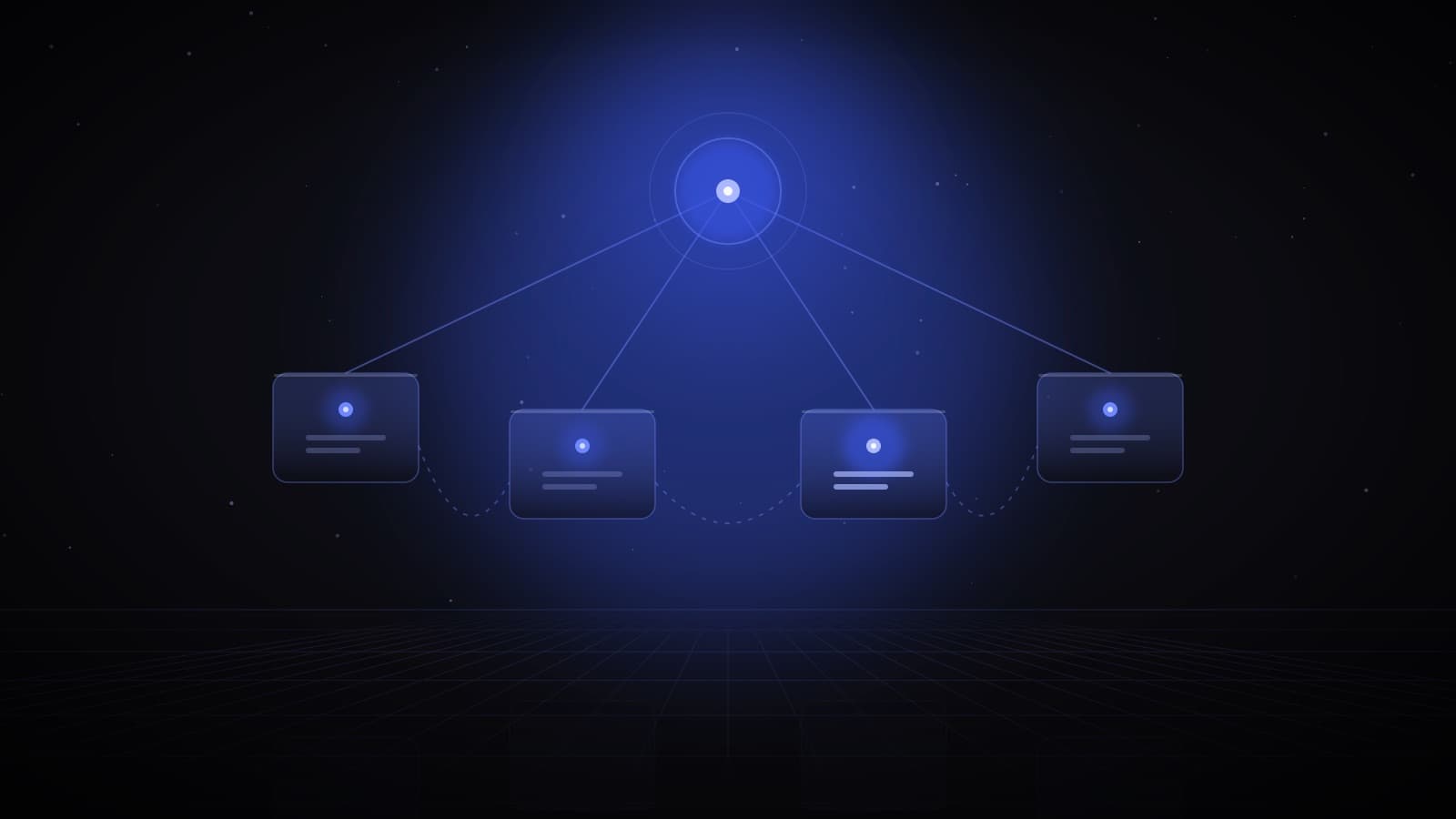
Most multi-agent systems follow a handful of patterns. The most common is the orchestrator-worker: a lead agent breaks a request into subtasks, sends them to specialist agents, and combines what comes back.
The orchestrator-worker pattern
- 01Plan
- Lead agent reads the goal
- Splits it into subtasks
One agent owns the plan
- 02Delegate
- Specialist agents
- Own context each
- Parallel where possible
Research, analysis, drafting
- 03Work
- Tools and data
- Search, read, calculate
Each specialist returns a summary
- 04Check
- Verifier or reviewer agent
- Rules and citations
Where most systems are weakest
- 05Combine
- Lead agent assembles
- Human approves actions
One voice in the final output
| Pattern | How it works | Best for |
|---|---|---|
| Orchestrator-worker (supervisor, manager) | A lead agent delegates to specialists and merges their results | Breadth-first research and analysis |
| Handoffs | The active agent passes the conversation to a better-suited peer | Customer triage and routing |
| Router | One classification step sends each request to the right agent | Simple, single-shot requests |
| Sequential pipeline | Agents run in a fixed order, each feeding the next | Repeatable business processes |
| Parallel fan-out | Agents work at the same time and results are merged | Speed, if a checking step follows |
| Hierarchical | Planners break goals down for sub-planners and workers | Very large, divisible projects such as code migrations |
| Generator and reviewer | One agent produces work; another critiques it until it passes | Quality control |
| Group chat or debate | Agents discuss and a manager decides | Open-ended exploration |
Every major framework now includes these patterns. OpenAI's Agents SDK supports handoffs and agents called as tools, Google's Agent Development Kit reached version 2.0 in May 2026 with graph-based multi-agent workflows, and Microsoft Agent Framework 1.0, released in April 2026 as the successor to AutoGen and Semantic Kernel, ships sequential, concurrent, handoff, group-chat and manager-led orchestration.
When do multi-agent systems beat a single agent?
When a task splits into independent parts that can be explored in parallel. When a task is sequential, or when one strong agent can already do it, adding agents usually makes results worse and always makes them more expensive.
What the data shows
What the evidence shows
- Anthropic, June 2025: its multi-agent research system, a Claude Opus 4 lead with Claude Sonnet 4 subagents, beat a single Opus 4 agent by 90.2% on an internal research evaluation, and parallel subagents cut research time by up to 90% on complex queries.
- Anthropic, February 2026: with a newer model, the gap on the BrowseComp benchmark was small: 86.57% for a multi-agent setup against 83.73% for the best single agent.
- Google, MIT and others, April 2026: across 260 configurations and six benchmarks, multi-agent setups ranged from +80.8% on decomposable financial reasoning to −70.0% on sequential planning; every multi-agent variant was 39% to 70% worse on planning tasks.
The same study found that once a single agent's success rate passed about 45%, adding agents produced negative returns, because coordination costs outweighed the remaining room for improvement. That's why the builders' advice converges. OpenAI recommends getting the most out of a single agent before splitting work across several, and splitting only for complex branching logic or tool overload.
The most instructive reversal came from Cognition, the maker of the Devin coding agent. In June 2025 it argued against building multi-agent systems; in April 2026 it said a narrower class works — setups where extra agents contribute intelligence, such as reviewers, but writes stay with a single agent.
Common misconception
"Multi-agent systems are about 90% better." That figure came from one internal evaluation with 2025 models. With a newer model, Anthropic's own multi-agent advantage on BrowseComp was under three percentage points, and independent research finds the benefit depends almost entirely on the shape of the task.
What do multi-agent systems cost?
Several times more than a single agent, mainly in tokens. Anthropic found agents use about four times the tokens of a chat, and multi-agent systems about 15 times, so they only pay off when the task is valuable enough.
- Tokens. In Anthropic's analysis, token usage alone explained 80% of the variance in research performance: more agents find more because they read more.
- Coordination. In the Google-MIT study, messages between agents added 58% to 515% over a single agent, depending on the architecture.
- Model mix. Cursor built the same SQLite project with different model combinations and got similar quality for costs ranging from $1,339 to $10,565; worker agents consumed at least 69% of the tokens, so putting cheaper models on the workers saved most.
- Scale. Anthropic's 16 parallel agents wrote a 100,000-line C compiler able to build the Linux kernel, over nearly 2,000 sessions and about $20,000 of API costs.
Why do multi-agent systems fail?
Mostly because of how they're designed and coordinated, not because the models are weak. Agents repeat steps, ignore their instructions, lose track of what others are doing, stop too early or never stop, and nobody checks the final answer properly.
What the data shows
Why multi-agent systems fail (MAST study, NeurIPS 2025)
- 1,642 annotated execution traces from seven open-source multi-agent systems; failure rates of 41% to 86.7%.
- 44.2% of failures come from system design, such as disobeying the task specification or repeating steps.
- 32.3% come from misalignment between agents, such as derailing the task or ignoring another agent's input.
- 23.5% come from task verification: stopping early, or checking incompletely or wrongly.
Errors also compound. In the Google-MIT study, agents working independently amplified errors 17.2 times, while a central orchestrator that checked work before combining it contained this to 4.4 times. Builders report the same problems in practice:
- Runaway delegation. Early versions of Anthropic's research system spawned 50 subagents for simple queries and distracted each other with excessive updates.
- Collisions. When Anthropic's compiler project became one giant task, all 16 agents hit the same bug and overwrote each other's fixes.
- Bottlenecks. In Cursor's experiments, flat agents coordinating through shared locks meant 20 agents ran at the effective throughput of two or three; a hierarchy of planners, workers and a judge worked instead.
- Conflicting assumptions. Cognition found parallel agents making incompatible decisions that nobody reconciled.
What frameworks and protocols do multi-agent systems use?
Most teams build on a vendor framework and connect agents through two open protocols: MCP, which links an agent to tools and data, and A2A, which links agents to each other.
| Layer | Main options (September 2026) |
|---|---|
| Frameworks | OpenAI Agents SDK; Microsoft Agent Framework 1.0; Google Agent Development Kit 2.0; LangGraph; CrewAI |
| Agent-to-tool protocol | MCP (Model Context Protocol), donated in December 2025 to the Linux Foundation's Agentic AI Foundation, co-founded by Anthropic, Block and OpenAI |
| Agent-to-agent protocol | A2A (Agent2Agent), version 1.0 in March 2026 with signed agent cards; joined the Agentic AI Foundation in August 2026 |
| Observability | Tracing in the frameworks (OpenAI's is on by default) and emerging OpenTelemetry conventions for agents |
The protocols are complementary, not competing: an agent might use MCP to read a CRM and A2A to ask another company's agent for a quote. How agents transact with each other is covered in agent-to-agent transactions, and where agents are distributed and sold in AI agent marketplaces.
How secure are multi-agent systems?
Less secure than single agents, because every message between agents is another place for an attack to enter and spread. Security bodies now treat inter-agent communication as its own risk category.
- New risk categories. The OWASP Top 10 for Agentic Applications, published in December 2025, lists insecure inter-agent communication (ASI07) and cascading failures (ASI08), alongside goal hijacking and rogue agents.
- Hijacking works. In a public red-teaming competition analysed by NIST's Center for AI Standards and Innovation, more than 400 participants made over 250,000 attack attempts on 13 frontier models in agentic scenarios, and at least one attack succeeded against every model.
- Trust boundaries. Treat messages from other agents like untrusted input, give each agent only the permissions it needs, and put a human approval gate before anything that pays, sends or signs.
These controls belong in a company's wider rules for autonomous AI — see AI governance.
Where are multi-agent systems used in business?
In research, software engineering, document-heavy processes and customer operations — mostly in pilots and early production, with results reported by the companies themselves.
| Organisation | What it does | Reported result |
|---|---|---|
| Allianz (Project Nemo, Australia) | Seven task-specific agents handle simple food-spoilage claims after storms, from coverage checks to fraud detection | 80% less claim processing and settlement time; under five minutes to final human review; a human makes every payout decision (company claim) |
| Anthropic (Research) | A lead agent directs parallel search subagents and a citation agent | 90.2% better than one agent on an internal evaluation (company claim) |
| Cursor | Planner, worker and judge agents on large coding projects | Over a million lines of code written by hundreds of concurrent agents (company claim) |
| Cognition (Devin) | A manager agent spawns child agents; a separate review agent checks each pull request | The review agent catches an average of two bugs per pull request, about 58% of them severe (company claim) |
Coding is the most mature use; the tools are covered in AI coding agents. For deciding which business processes to hand to agents at all, see AI agents for business.
What is the UAE doing with agentic and multi-agent AI?
The UAE federal government has committed to moving half its sectors, services and operations to agentic AI within two years, and some entities already run networks of collaborating agents.
- The framework. In April 2026 the UAE announced a framework to transform 50% of government sectors, services and operations into agentic AI models within two years, with ministers assessed on the speed of adoption.
- First agents. In May 2026 the government launched its first cohort of four AI agents, for procurement, tax auditing, customer happiness and technical support, and began training 80,000 federal employees in agentic AI tools.
- A multi-agent example. In June 2026 the National Centre of Meteorology deployed two agentic assistants built on a network of autonomous but collaborating agents on one platform, with specialists making every final decision.
- Real estate. Dubai Land Department's AI advertising platform had monitored more than 279,000 property ads on Property Finder, Dubizzle and Bayut by April 2025, and 29% of them had been modified automatically — AI in the regulator's workflow, though not described as multi-agent. The wider landscape is in the Dubai proptech guide.
How could real-estate firms use multi-agent systems?
Where work splits into parallel research or checkable steps. We found no verified real-estate multi-agent deployment that publishes outcome data, so the uses below are patterns the evidence supports, not proven results.
| Use | Pattern | Why it fits | Watch out for |
|---|---|---|---|
| Market and land due diligence | Orchestrator with parallel research agents; one agent writes the report | Breadth-first research is where multi-agent systems gain most | Token costs; verify every figure |
| Transaction documents (sales contracts, KYC, escrow paperwork) | Sequential specialists with an audit agent and human sign-off | Mirrors the claims-processing pattern | Keep humans on payments and approvals |
| Listing compliance and marketing copy | Generator and reviewer | Reviewers catch missing permit numbers and banned claims | The reviewer needs explicit rules to check |
| Lead and customer triage | Router or handoffs | Routes enquiries to the right specialist agent or person | No published production metrics yet |
Should you build a multi-agent system?
Only after a single agent has hit a real limit. Start with one well-equipped agent, measure it, and add agents where the task genuinely splits.
- Start single. Split only when one agent struggles with too many tools, overlapping instructions or a task that clearly divides into parallel parts.
- Match the pattern to the task. Parallel for research, sequential for processes, handoffs for triage; avoid multi-agent designs for step-by-step planning.
- Add a checker. A verification or review agent with clear rules is the difference between 4.4 and 17.2 times error amplification.
- Mix models. Use a strong model to plan and cheaper models to do the work.
- Trace everything. Log every agent's inputs, outputs and tool calls so failures can be diagnosed.
- Gate the actions. Anything that pays, sends, signs or deletes needs a human approval step.
- Budget for tokens. Price the task at several times single-agent cost before you promise savings.
What comes next for multi-agent systems?
More adoption, more cancellations and more standards, in that order. Gartner lists multiagent systems among its top strategic technology trends for 2026, while placing agentic AI at the peak of its hype cycle.
- Adoption: Gartner's 2026 CIO survey found 17% of organisations had deployed AI agents, with more than 60% expecting to within two years.
- Cancellations: Gartner forecasts that over 40% of agentic AI projects will be cancelled by the end of 2027, and that 40% of enterprises will demote or decommission autonomous agents by 2027 because of governance failures.
- Standards: MCP and A2A are now governed together under the Agentic AI Foundation, and NIST launched an AI Agent Standards Initiative in February 2026.
- UAE: the federal target of 50% of government operations on agentic AI falls due in 2028.
Final takeaway
Multi-agent systems are teams of AI agents, and like human teams they're worth their overhead only when the work can genuinely be divided. They shine on broad, parallel research and on checkable pipelines with a reviewer in the loop; they struggle on sequential reasoning and cost several times more than a single agent. The evidence points to a disciplined approach: start with one agent, split the work only where it divides, put a verifier and a human gate in the loop, and use cheaper models for the workers. For UAE organisations facing a government-wide push to agentic AI, that discipline is the difference between a working team and an expensive argument between bots.
AI strategy
Working out where AI fits in your business?
I help teams separate the use cases worth automating from the ones that only demo well — then build the workflow, the integrations and the guardrails.
Sources
Primary sources checked for this article. Figures reflect the dates shown.
- How we built our multi-agent research system — Anthropic, June 13, 2025
- System Card: Claude Opus 4.6 — Anthropic, February 2026
- Why Do Multi-Agent LLM Systems Fail? — arXiv (UC Berkeley et al.; NeurIPS 2025 Datasets and Benchmarks), October 26, 2025
- Towards a Science of Scaling Agent Systems — arXiv (Google Research, Google DeepMind, MIT et al.), April 8, 2026
- A practical guide to building agents — OpenAI, April 2025
- Agent orchestration — OpenAI Agents SDK — OpenAI
- Don't Build Multi-Agents — Cognition, June 12, 2025
- Multi-Agents: What's Actually Working — Cognition, April 22, 2026
- Building a C compiler with a team of parallel Claudes — Anthropic, February 5, 2026
- Scaling long-running autonomous coding — Cursor, January 14, 2026
- Agent swarms and the new model economics — Cursor, July 20, 2026
- When the storm clears, so should the claim queue — Allianz, November 3, 2025
- Microsoft Agent Framework Version 1.0 — Microsoft, April 3, 2026
- Release v2.0.0 · google/adk-python — Google (GitHub), May 19, 2026
- A2A Protocol Ships v1.0: Production-Ready Standard for Agent-to-Agent Communication — A2A Protocol (Linux Foundation), March 12, 2026
- A New Chapter for A2A: Joining the Agentic AI Foundation — A2A Protocol (Linux Foundation), August 27, 2026
- Donating MCP to the Agentic AI Foundation — Anthropic, December 9, 2025
- Gartner Predicts Over 40% of Agentic AI Projects Will Be Canceled by End of 2027 — Gartner, June 25, 2025
- What the 2026 Hype Cycle for Agentic AI Reveals — Gartner, April 15, 2026
- Gartner Says Applying Uniform Governance Across AI Agents Will Lead to Enterprise AI Agent Failure — Gartner, May 26, 2026
- OWASP Top 10 for Agentic Applications - The Benchmark for Agentic Security in the Age of Autonomous AI — OWASP GenAI Security Project, December 9, 2025
- Insights into AI Agent Security from a Large-Scale Red-Teaming Competition — NIST (CAISI), March 23, 2026
- Mohammed bin Rashid unveils framework to deploy agentic AI across 50% of government sectors within 2 years — Government of Dubai Media Office, April 23, 2026
- Mohammed bin Rashid Al Maktoum attends national retreat on UAE Government's Agentic AI project — Government of Dubai Media Office, May 20, 2026
- NCM launches country's first Agentic AI assistants for meteorological sector — Emirates News Agency (WAM), June 29, 2026
- Dubai Land Department strengthens transparency with AI-enabled real estate advertising governance — Dubai Land Department, April 2025