Personal AI Agents Across Devices: What They Do, and What to Trust
On this page
A personal AI agent is an AI assistant tied to one person's accounts, data and memory that can act on their behalf across devices: booking, emailing, shopping and following up in the background. By September 2026, Google, Meta, xAI and Microsoft had launched one and Apple had shipped a rebuilt Siri, but most still pause for approval before sensitive actions.
This guide explains how personal AI agents work across your phone, laptop, car and wearables, compares the main products and their availability, and covers what matters most before you hand one the keys: memory, identity, payments and security — with the UAE picture and what it means for property businesses.
Key takeaways
- 2026 made personal agents a product category. Google's Gemini Spark (May), xAI's Grok Bot (August), Meta's Muse (September) and Microsoft's Autopilot (announced September) all act for you; Apple's Siri AI arrived in beta on 14 September.
- The agent lives in the cloud, not on your phone. Spark runs on dedicated Google Cloud machines and Muse on its own secure virtual machine — so it keeps working when your devices are off, and every device becomes a window onto the same agent.
- Memory is the product — and the risk. ChatGPT, Claude and Gemini now remember across chats; retention rules differ widely, and "off" doesn't always mean nothing is kept.
- Adoption is early. 24% of US AI users use an agent regularly, according to Menlo Ventures' 2026 survey — though 32% have let AI act without final approval.
- UAE users face gaps. Siri AI is English-only, Apple Intelligence doesn't support Arabic, and Alexa+ isn't offered in the UAE.
What is a personal AI agent?
A personal AI agent is software that knows one person — their accounts, preferences and history — and takes actions for them across apps and devices, usually continuing in the background until the job is done or it needs a decision.
Definition
Personal AI agent — an AI agent bound to a single person's identity, data and memory, that plans and carries out multi-step tasks across that person's apps and devices, within permissions they grant and with approval steps for sensitive actions.
There's no standard definition, so vendors describe the same idea differently. Google calls Spark "your 24/7 personal AI agent"; Meta says Muse "doesn't just answer questions, it actually does the work"; Microsoft describes Autopilot as a persistent, proactive and personal agent that keeps working when you don't. The agentic AI guide explains what makes any system an agent — goals, planning, tools and autonomy.
| AI assistant | Personal AI agent | |
|---|---|---|
| Starts work | When you ask | When you ask, on a schedule, or when something changes |
| Output | Answers, drafts, suggestions | Completed tasks: emails sent, bookings made, forms filled |
| Memory | Often per conversation | Long-term memory across chats and devices |
| Where it runs | Your device or a chat window | Often its own cloud computer, working in the background |
| Control | You act on its advice | You approve sensitive steps; it acts on the rest |
How do personal AI agents work across devices?
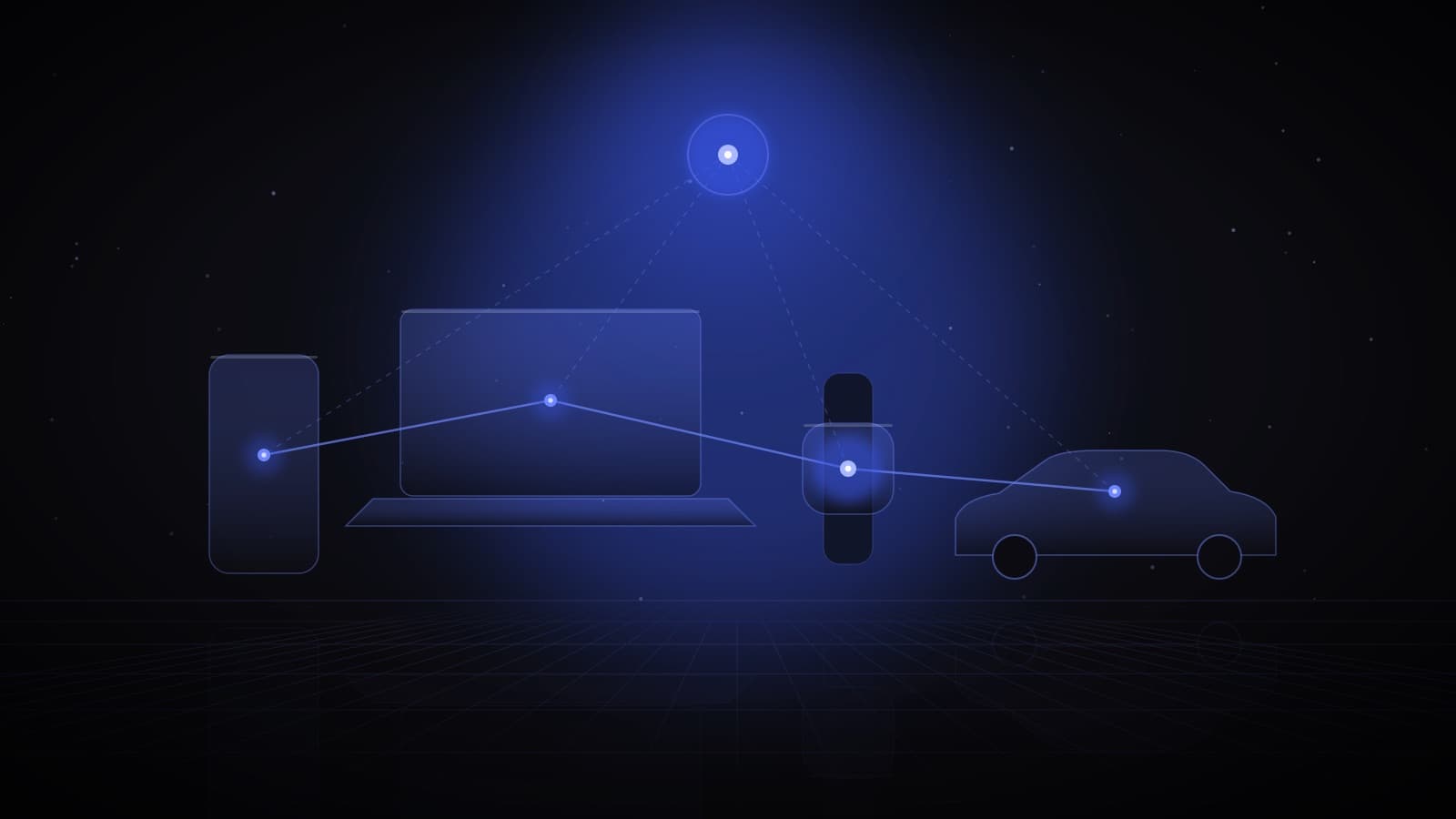
They work across devices by moving the agent off the device: the agent, its memory and your connected accounts live in the cloud, and your phone, laptop, car and wearables become interfaces onto the same agent.
Anatomy of a personal AI agent
- 01Identity
- Your account
- Passkeys
- Delegated access
The agent acts as you, with permissions you grant
- 02Memory
- Saved facts
- Past chats
- Preferences
What it knows about you, and what you can edit or delete
- 03Connectors
- Calendar
- Shopping
- Files
The apps it can read from and act in
- 04Cloud computer
- Browser
- Background tasks
- Isolation
Keeps working when your devices are off
- 05Devices
- Phone
- Laptop
- Car
- Wearables
Different windows onto the same agent
- 06Approvals
- Payments
- Sending
- Deleting
Sensitive steps come back to you
The architecture is converging. Google says Spark runs on dedicated virtual machines on Google Cloud so you don't need to keep your laptop open. Meta's Muse runs on "Muse Secure VM", a dedicated cloud computer with its own browser, and a separate "Sentinel" agent must approve anything that reaches the internet. xAI says Grok Bot agents have "their own computer" and work 24/7. Apple takes a different route: Siri AI runs on-device and on Apple's Private Cloud Compute, syncing conversations across iPhone, Mac, iPad, Apple Watch and Vision Pro through iCloud. The operating systems themselves are growing an agent layer too — see AI-native operating systems.
Which devices can a personal AI agent reach?
In 2026, agents are strongest on phones and laptops, spreading fast into cars, and just arriving on glasses and watches.
- Phone. Siri AI on iPhone; Google's Gemini on Android; Samsung's Galaxy S26 offers a choice of agents, including Gemini and Perplexity.
- Laptop and browser. Spark works through Chrome; Microsoft's Copilot is built into Windows and Edge; Lenovo and Motorola's Qira runs across PCs, phones and a watch.
- Car. Gemini is rolling out in Android Auto and, from GM, to about 4 million 2022-and-newer US vehicles with Google built-in; BMW's new iX3 assistant uses Alexa+ technology; ChatGPT works in Apple CarPlay; Grok is in beta in some Teslas.
- Wearables. Gemini is on Samsung's newest Galaxy Watch, Gemini glasses are announced for this autumn, and Meta says Muse is coming to its AI glasses "in the coming months". AI glasses and other always-on devices are the next interface — see AI wearables for the hardware race, and voice AI agents for how voice already works as an agent interface.
Which personal AI agents are available in 2026?
Six big platforms now offer personal agents or agent-like assistants, with very different availability, pricing and design.
| Product | Company | Where the agent runs | Status, September 2026 | Access |
|---|---|---|---|---|
| Siri AI | Apple | On device and Apple's Private Cloud Compute | Beta since 14 September; English only; not in the EU or China | Free on supported devices; Apple says expanded access may cost extra later |
| Gemini Spark | Dedicated Google Cloud virtual machines | Rolling out; Chrome browsing integration in the US first | Google AI Pro and Ultra subscribers | |
| Muse | Meta | "Muse Secure VM" in Meta's cloud | Launched in the US on 8 September; app, web and WhatsApp | Free to start (a payment card is required); paid plans at $20 and $100 a month for heavier use, per TechCrunch |
| Grok Bot | xAI | Its own cloud computer | Beta since August | SuperGrok subscribers |
| Autopilot | Microsoft | Cloud, inside the company's Microsoft 365 tenant | Private preview for work users | Business customers |
| Alexa+ | Amazon | Amazon's cloud | Available in the US and Canada; early access in 10 more countries | Free with Prime in the US, otherwise $19.99 a month |
| ChatGPT | OpenAI | OpenAI's cloud | Agent mode and memory live; more than 900 million weekly users | Agent mode on paid plans |
Open-source agents such as OpenClaw sit outside this list: self-hosted, extensible and popular with developers, but with a security record covered below. For a gentler open-source route with memory you can read, see the OpenHuman setup guide.
Apple and Google are now also partners: in January 2026 the two companies said the next generation of Apple's foundation models would be based on Google's Gemini models and cloud technology, while Apple Intelligence keeps running on-device and on Private Cloud Compute.
How does memory work in personal AI agents?
Memory lets an agent act on what you told it once, months ago — which is what makes it useful, and why its controls matter more than any feature list.
ChatGPT can draw on saved memories, past chats, custom instructions, files and connected apps such as Gmail. It began referencing all past chats in April 2025 for paid users and June 2025 for free users. You can view, edit and delete memories, switch memory off or use a temporary chat, which never creates memories — but OpenAI notes that switching memory off doesn't disable limited safety uses of context in rare, high-risk situations.
Claude has used one memory across chat and its Cowork agent since August 2026. You can see what it remembers topic by topic and edit or delete it; by default it doesn't store sensitive subjects such as health or religious beliefs unless you turn that on.
Gemini deletes activity after 18 months by default (3 months, 36 months or never are options). Temporary chats, and chats with activity switched off, are still kept for 72 hours; chats seen by human reviewers are kept for up to three years even if you delete your activity. Its Personal Intelligence feature, which draws on Gmail, Photos and other Google apps, is off by default.
Meta's Muse lets you tell it to "forget" specific things, and Meta says Muse doesn't share your conversations or VM data with its ad systems. That's worth knowing because, since 16 December 2025, Meta has used people's interactions with its other AI features to personalise content and ads.
| Question to ask | Why it matters |
|---|---|
| Can I see everything it remembers? | Hidden memory can't be corrected |
| Can I delete a memory, and is it really deleted? | Retention rules differ: 72 hours, 18 months, three years |
| Is memory used for ads or training? | Some platforms personalise ads from AI chats |
| Can I keep work and personal memory apart? | Mixed memory leaks context between roles |
| Can I take my memory with me? | Gemini imports chat history and memories from other AI apps; lock-in varies |
How do personal AI agents log in and pay for things?
The safest designs let the agent use your credentials and payment methods without ever seeing them, and hand anything irreversible back to you.
- Logins. With your permission, Spark can use your logged-in accounts and saved passwords through Chrome. Meta says Muse stores credentials so the agent can use them without seeing them, including passwords you type yourself. OpenAI is rolling out "Sign in with ChatGPT" on partner sites.
- Payments. Spark hands payments back to you. Muse checks with you before purchases and can pay with Stripe's Link wallet for agents, which generates a one-time-use card so your real card details stay hidden.
- Standards. The FIDO Alliance — the body behind passkeys — said in April 2026 that today's authentication was designed for direct human interaction, not delegated, agent-initiated actions, and set up a working group on agent authentication.
When an agent buys from a business that runs its own agents, the transaction moves onto the rails described in the agent-to-agent transactions guide.
What are the risks of personal AI agents?
The biggest risks are manipulation through prompt injection, over-broad access to accounts, weak security in self-hosted agents, data reuse and product churn.
- Prompt injection isn't solved. OpenAI has said prompt injection is unlikely ever to be fully "solved", and the UK's National Cyber Security Centre has warned it may never be totally mitigated. An agent that reads your email and browses the web can be tricked by text hidden in either.
- Access is power. An agent with your saved passwords can do anything you can. Grant connectors one at a time, start read-only, and review what each can do.
- Self-hosted agents can be dangerous. OpenClaw — the open-source agent formerly called Clawdbot and Moltbot — had a high-severity flaw, CVE-2026-25253, that could leak its access token; security firm Hunt.io counted more than 17,500 exposed instances. Microsoft advises treating OpenClaw as "untrusted code execution with persistent credentials" and running it only in an isolated environment.
- Data reuse. Check whether your agent's conversations feed advertising or model training; the answer differs by company and by setting.
- Products disappear. OpenAI shut down its Pulse briefing feature in June 2026 and its Atlas browser in August 2026, less than a year after launch. Don't build routines you can't move.
Common misconception
"Vendor security claims mean an agent is safe." They're a start, not proof. Meta's Muse design — isolated VM, a separate approval agent, credentials the agent can't see — is promising, and Meta runs a bug bounty paying up to $300,000; TechCrunch noted its claims still need independent scrutiny. Treat any new agent as you would a new employee: limited access first, more as it earns trust.
What does the latest data show?
Reach is enormous and daily use of chat assistants is mainstream, but regular use of agents is still a minority habit.
What the data shows
- Reach (company figures): Gemini app, more than 1 billion monthly users (August 2026); ChatGPT, more than 900 million weekly users and more than 50 million subscribers (March 2026); Meta AI, more than 1 billion monthly users (October 2025). — Google, OpenAI, Meta
- Agent use (survey of US adults, fielded July 2026): 64% of US adults use AI; among AI users, 41% have tried an AI agent, 24% use one regularly and 32% have let AI act on their behalf without final approval. — Menlo Ventures
- Holdouts (same survey): 76% of people who don't use AI cite privacy. — Menlo Ventures
- Passkeys (estimate, May 2026): about 5 billion passkeys in use worldwide. — FIDO Alliance
What this means
Most people already use an assistant; far fewer let one act. The gap is trust — in accuracy, in privacy and in what happens when something goes wrong. Agents that show their work, ask before anything irreversible and make memory easy to inspect will close it fastest.
What does this mean for the UAE?
UAE residents can use most personal agents in English, but several flagship features aren't available here yet, Arabic support is uneven, and local privacy law gives people rights over automated decisions.
- Language gaps. Siri AI launched in English only, and Apple Intelligence's supported languages don't include Arabic. Google's Gemini and Microsoft's Copilot do accept Arabic.
- Availability gaps. Alexa+ isn't offered in the UAE; Amazon plans more than 10 additional countries in 2027 without naming them. Gemini's Chrome-based Spark features launched in the US first.
- Privacy law. The UAE's Personal Data Protection Law (Federal Decree-Law No. 45 of 2021) gives people the right to object to decisions made by automated processing, including profiling, when they have legal or adverse effects — with exceptions for contracts, other laws and prior consent.
- Government agents. The UAE targets agentic AI across half of government sectors within two years, set in April 2026 — so residents will increasingly deal with agents on the other side of government services too.
Common misconception
"Every UAE resident gets ChatGPT Plus for free." That claim spread after OpenAI announced Stargate UAE in May 2025, but it was never confirmed. Emirates 24|7 reported that the claims weren't based on any official confirmation, and OpenAI's announcement described enabling ChatGPT nationwide, not free individual subscriptions. Stargate UAE is a 1GW AI computing cluster in Abu Dhabi, with the first 200MW expected in 2026.
How will personal AI agents affect real estate?
Personal agents will increasingly handle the admin of a property search — shortlisting, booking viewings, chasing documents — which means brokerages will talk to buyers' agents before they talk to buyers.
Google's own example of what Spark can do through Chrome is "scheduling viewings for apartments you've saved". Zillow and Bayut already run property-search apps inside ChatGPT, and Aldar customers pay service charges through an AI agent. For brokerages, three things follow:
- Answer fast and in structured form. An agent booking viewings will favour listings it can book without back-and-forth. Speed-to-lead matters even more — see AI lead routing.
- Keep listing data complete and consistent. Price, size, service charges, handover dates and permit details are what an agent compares.
- Make the human handover obvious. Agents will book and ask; people still negotiate and sign. A WhatsApp-first sales process and an agentic CRM are where that handover happens.
How should you set up a personal AI agent safely?
Start narrow: one ecosystem, read-only connectors, approval on anything that spends, sends or deletes, and a monthly look at what it remembers.
- Pick by ecosystem. Choose the agent that lives where your email, calendar and files already are — Apple, Google, Microsoft or Meta.
- Connect one app at a time. Start with read access to calendar and email; add sending and booking once it's proven useful.
- Keep money behind approval. Use one-time or agent-specific cards where offered; never paste card numbers or passwords into a chat.
- Review memory monthly. Delete what's wrong or sensitive; use temporary chats for anything you don't want remembered.
- Separate work and personal. Use your company's approved agent for work data — it's covered by company policy and, often, by stronger controls.
- Don't self-host on your main machine. If you experiment with open-source agents, isolate them in a separate virtual machine, as Microsoft advises for OpenClaw.
- Check availability before you commit. Confirm the features you need work in your country and language.
| If you mostly use… | Start with | Watch out for |
|---|---|---|
| iPhone, Mac, Apple Watch | Siri AI (beta) | English only; server features have daily limits |
| Android, Gmail, Google Calendar | Gemini, then Spark | Spark's Chrome actions launched in the US first; review retention settings |
| WhatsApp and Meta apps (US) | Muse | New product; paid tiers for heavy use |
| Microsoft 365 at work | Copilot and Autopilot | Follow company policy; Autopilot is in preview |
| Echo devices | Alexa+ | Not available in the UAE |
| Developer tools, self-hosting | OpenHuman or OpenClaw | Isolation and patching are your job |
What is likely to happen next?
Expect agents to move onto glasses and watches, identity and payment standards to mature, and a shake-out as products that don't earn daily use are cut.
- New devices. Muse is coming to Meta's glasses and a pocket device called Muse Charm; Gemini glasses are due this autumn; OpenAI's first device won't ship before the end of February 2027, according to a court filing reported by WIRED.
- More languages. Siri AI adds French, Japanese, Korean, Portuguese and Spanish next; Arabic isn't on Apple's announced list.
- Standards. FIDO's agent authentication work and payment tokens that keep card details hidden will decide how much agents can safely do.
- Consolidation. OpenAI has already folded features into its core products; expect others to follow.
Final takeaway
Personal AI agents arrived in force in 2026: they live in the cloud, follow you from phone to laptop to car, and remember what you tell them. The value is real — fewer errands, less admin — and so are the risks: prompt injection, over-broad access and memory you can't see. Choose the agent that fits your ecosystem, give it narrow permissions, keep money and messages behind approval, and check its memory the way you'd check a bank statement.
AI strategy
Working out where AI fits in your business?
I help teams separate the use cases worth automating from the ones that only demo well — then build the workflow, the integrations and the guardrails.
Sources
Primary sources checked for this article. Figures reflect the dates shown.
- Siri AI, a profoundly more capable and personal assistant, is here — Apple, September 14, 2026
- Joint statement from Google and Apple — Google, January 12, 2026
- How to get the next generation of Apple Intelligence — Apple Support
- Google I/O 2026: Sundar Pichai's opening keynote — Google, May 19, 2026
- Gemini Spark: new Chrome browsing integration — Google, July 30, 2026
- Google's Gemini app hits 1 billion monthly active users — Google, August 11, 2026
- Gemini Apps Privacy Hub — Google
- Introducing Muse: The World's First Personal AI Agent Built for Everyone — Meta, September 8, 2026
- Meta debuts its Muse AI agent. Will consumers trust it? — TechCrunch, September 8, 2026
- Improving Your Recommendations on Our Apps With AI at Meta — Meta, October 1, 2025
- Introducing Grok Bot — xAI, August 11, 2026
- Introducing the new Copilot with Home, Code and Autopilot — Microsoft, September 25, 2026
- OpenAI raises $122 billion to accelerate the next phase of AI — OpenAI, March 31, 2026
- Memory in ChatGPT — OpenAI Help Center
- ChatGPT — Release Notes — OpenAI Help Center
- Claude's memory works everywhere, and you decide what's in it — Anthropic, August 25, 2026
- Alexa+ launches in India: Amazon's next-gen AI assistant expands internationally — Amazon, September 16, 2026
- GM brings Google Gemini to millions of vehicles on the road — General Motors, April 28, 2026
- Running OpenClaw safely: identity, isolation, and runtime risk — Microsoft Security Blog, February 19, 2026
- CVE-2026-25253 — NIST National Vulnerability Database, February 1, 2026
- Samsung Unveils Galaxy S26 Series: The Most Intuitive Galaxy AI Phone Yet — Samsung, February 25, 2026
- A Milestone for Human-Vehicle Interaction. BMW Intelligent Personal Assistant expanded to include Amazon Alexa + Technology. — BMW Group, January 5, 2026
- Continuously hardening ChatGPT Atlas against prompt injection attacks — OpenAI, December 22, 2025
- Prompt injection is not SQL injection (it may be worse) — National Cyber Security Centre (UK), December 8, 2025
- Hunting OpenClaw Exposures: CVE-2026-25253 in Internet-Facing AI Agent Gateways — Hunt.io, February 3, 2026
- Lenovo & Motorola Qira Expands Its Reach Across Devices, Apps and Markets — Lenovo, September 3, 2026
- FIDO Alliance to Develop Standards for Trusted AI Agent Interactions — FIDO Alliance, April 28, 2026
- The State of Consumer AI: 2026 Statistics & Trends — Menlo Ventures, September 16, 2026
- New UAE government framework to deploy Agentic AI across 50% of government sectors and operations within two years — UAE Cabinet, April 23, 2026
- Introducing Stargate UAE — OpenAI, May 22, 2025
- No Free ChatGPT Plus Subscriptions in the UAE — Emirates 24|7, May 28, 2025
- Federal Decree by Law Concerning the Protection of Personal Data (No. 45 of 2021) — UAE Legislation, September 20, 2021